
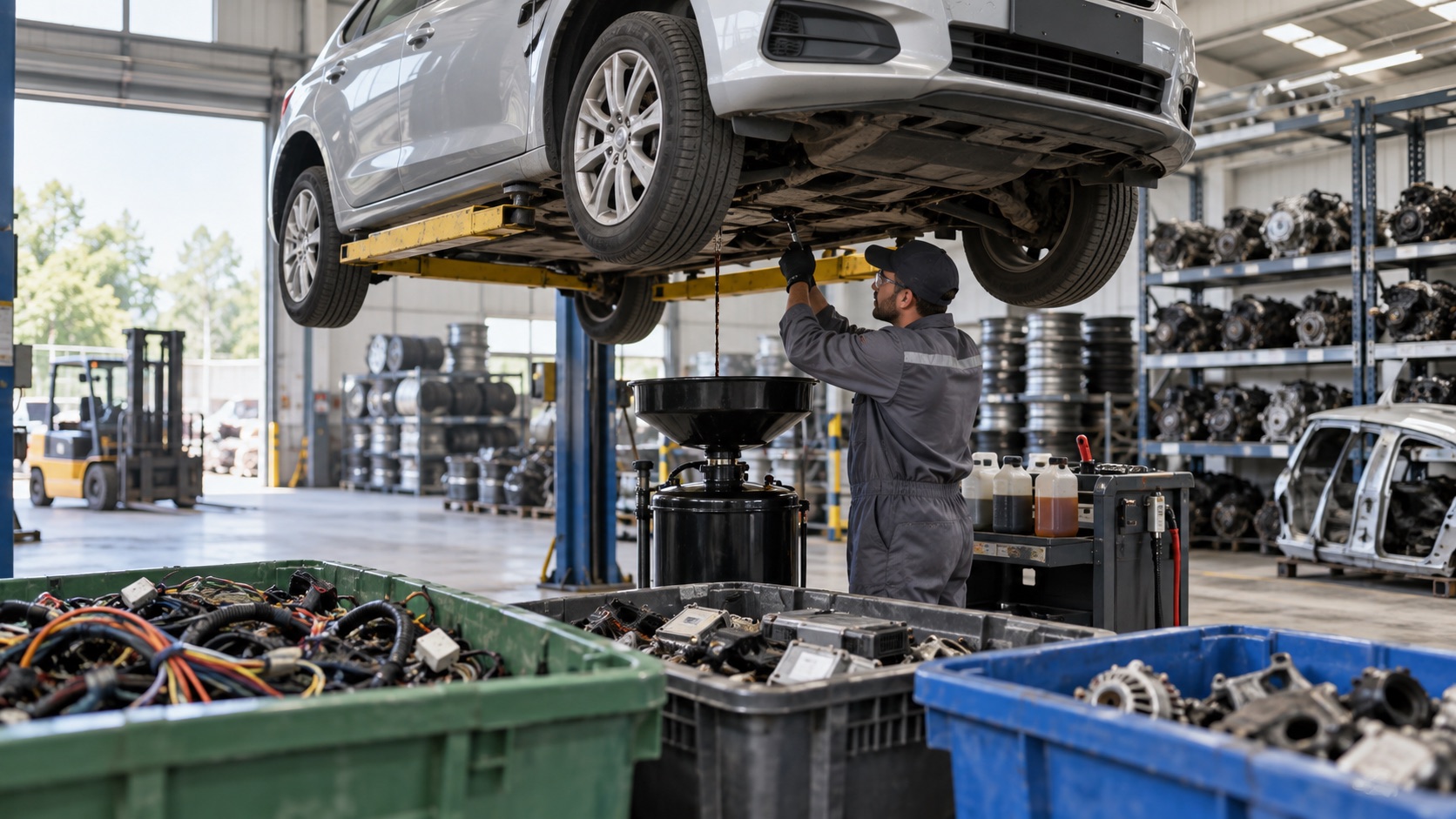
When a car reaches the end of its life, many people think about scrap metal.
That makes sense. Cars contain steel, aluminum, copper, and other valuable metals. Automotive recycling has long recovered useful parts and metals from old vehicles.
But modern cars are more than metal.
They include plastics, foam, fabric, glass, rubber, electronics, wires, fluids, adhesives, coatings, and safety materials. After reusable parts and major metals are removed, the remaining mixed material can be harder to manage.
In August 2026, the European Commission announced new end-of-life vehicle rules focused on circularity in vehicle design and management. The Commission noted that every year, 10 to 12 million vehicles in Europe reach the end of their life and are treated as waste.
This topic is relatable because almost every community has vehicles, repair shops, scrap yards, tow companies, dealerships, insurance claims, and old-car storage.
A damaged or retired vehicle may pass through many stages. It may be towed, repaired, sold for parts, dismantled, crushed, shredded, or exported. Useful parts may get another life. Metals may be recycled. Fluids and hazardous components may need proper handling. Plastics and mixed materials may be more difficult.
The next challenge in vehicle recycling is not only recovering metal. It is understanding everything else inside the vehicle.
As cars become more complex, end-of-life planning becomes more important. New vehicles may include more electronics, sensors, plastics, lightweight materials, composites, and embedded systems. That can make future recycling more complicated unless design and recovery are considered together.
This is not about criticizing vehicles or manufacturers. Cars are essential for many people and communities. The point is that products with many materials need thoughtful after-use systems.
For local governments, old vehicles can also affect neighborhoods, storage yards, illegal dumping, stormwater, fire risk, and land use. For industry, they affect supply chains, recovered materials, and design decisions.
For The Promise Worldwide, old vehicles are part of the larger awareness conversation around complex modern waste. The more materials a product contains, the more important it becomes to plan for what happens when that product is no longer useful.
Key Insight
Vehicle recycling is strong for metals, but modern cars also contain plastics, electronics, fluids, and mixed materials that make end-of-life planning more complex.